A nuclear power plant does not generate electricity directly. Like coal and gas plants, it first produces heat, then converts that heat into electrical energy.
The key difference is where the heat comes from: nuclear fission. During fission, a heavy atom is split, releasing a large amount of energy.
In France, nuclear energy provides most of the country's electricity, yet the way a plant works is often misunderstood.
The goal of this article is simple: explain how a nuclear power plant works, even without a background in nuclear physics or electrical engineering.
Disclaimer: this article is educational and simplified.
Inside a nuclear power plant
A nuclear power plant includes:
- The reactor, where fission happens
- The turbine hall, where heat is converted into electricity
- The power lines, which carry electricity to the grid
- Cooling systems (often with cooling towers and nearby water sources)
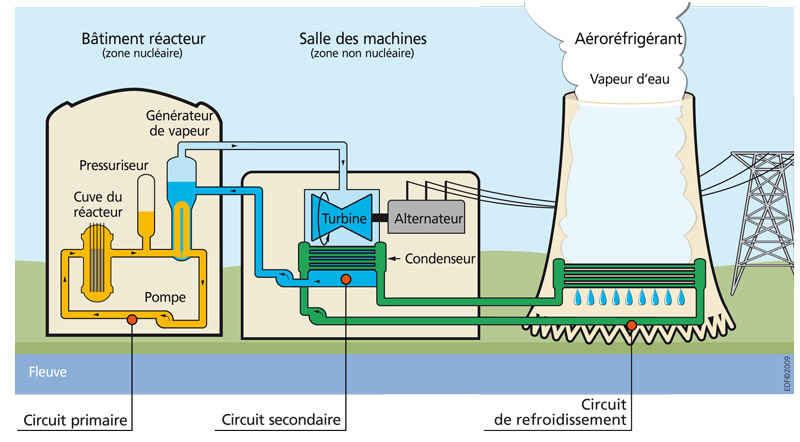
The three water circuits
Most plants use three separate water circuits:
Primary circuit
Fission heats water to about 320 C under high pressure so it does not boil. This heat is transferred to a steam generator.
Secondary circuit
Water turns into steam, the steam spins a turbine, and the turbine drives an alternator (generator) to produce electricity.
Tertiary circuit
After the turbine, steam is cooled in a condenser and turns back into liquid water. External water (river, sea, or cooling tower loop) removes this heat.
Heat becomes electricity
Turbine
Steam pushes turbine blades at high speed, converting thermal energy into mechanical rotation.
Alternator
The rotating shaft spins a magnetic field inside copper coils, generating alternating current.
Transformer
Voltage is increased (for example from around 20 kV to hundreds of kV) so electricity can travel long distances efficiently with lower losses.
The reactor
Several reactor designs exist:
- Pressurized Water Reactor (PWR), the most common worldwide
- Boiling Water Reactor (BWR)
- Heavy-water reactor
- Fast-neutron reactor
- Gas-cooled reactor
Most nuclear sites have multiple reactors. In all cases, the reactor vessel contains the fuel and is where fission energy is released.
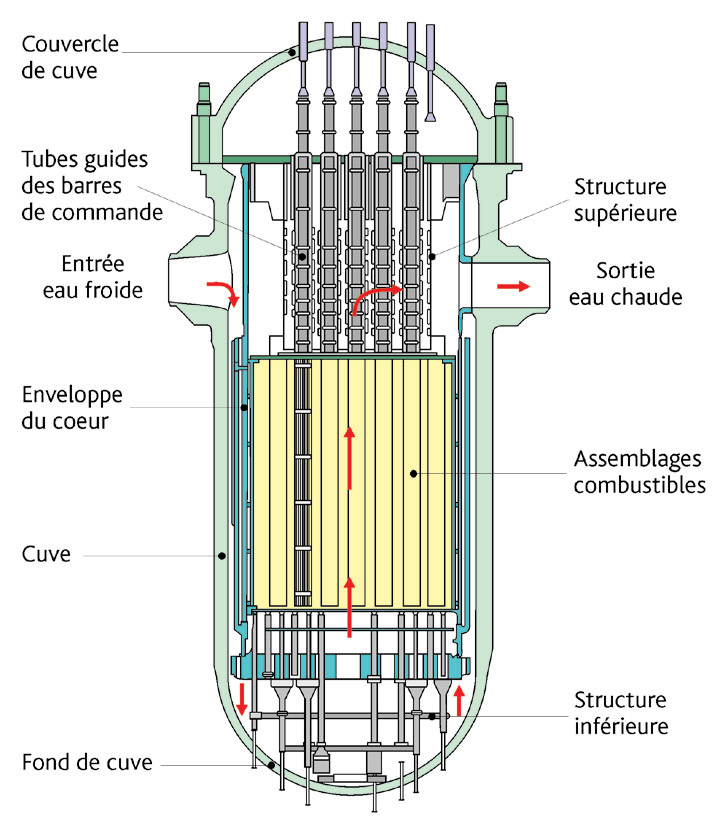
To understand fission, we first need the basics of atoms.
The atom
An atom contains:
- Protons
- Neutrons
- Electrons
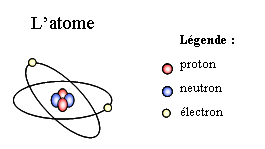
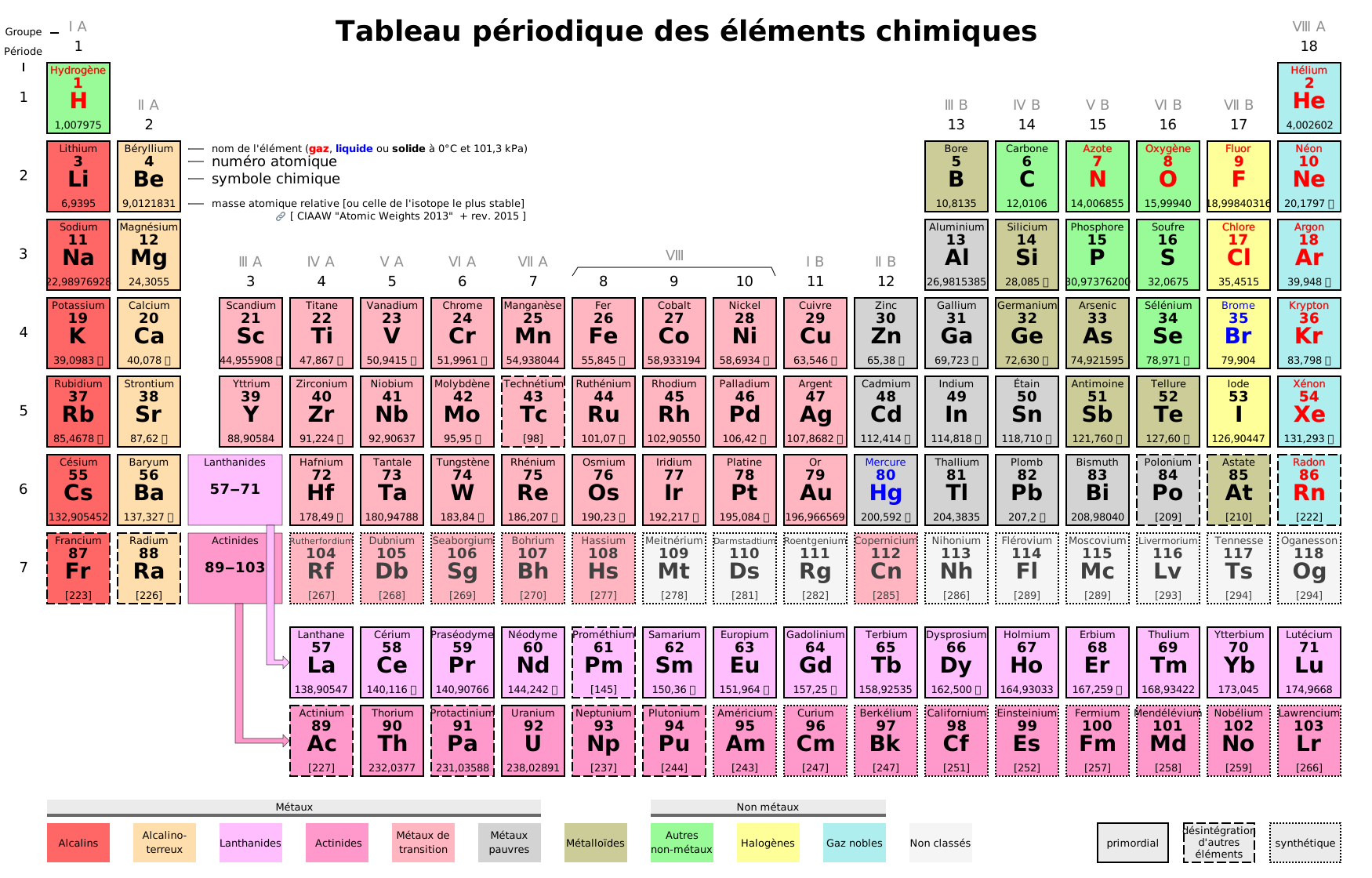
The nucleus contains protons and neutrons. The number of protons defines the element (for example, hydrogen has 1 proton).
Atoms of the same element can have different numbers of neutrons: these are isotopes (such as uranium-235).
Nuclear fission
In a reactor, a neutron is absorbed by a fissile nucleus (mainly uranium-235). The nucleus becomes unstable and splits into lighter nuclei, releasing:
- A large amount of heat
- Additional neutrons
- Radiation
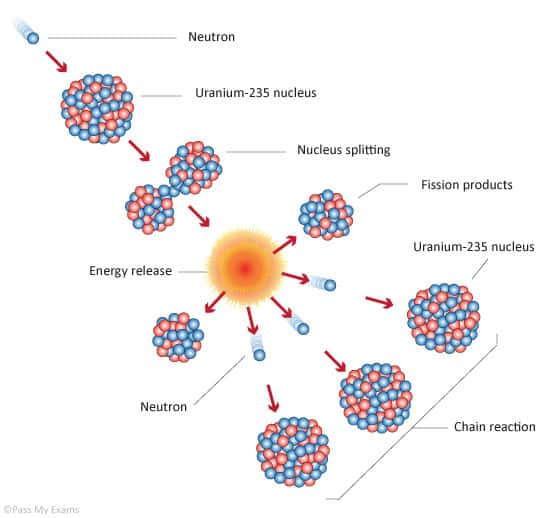
The emitted neutrons can trigger more fissions: this is the chain reaction.
E = mc2
Einstein's equation explains why fission releases so much energy.
A very small loss of mass is converted into energy, and the conversion factor is huge because it is multiplied by the square of the speed of light.
Energy = Mass x (Speed of light)2
Why uranium
To fission efficiently, a nucleus must be heavy and fissile. Uranium and plutonium are key fissile materials used in reactors.
Natural uranium contains only about 0.72% uranium-235, so it is enriched to around 3-4% for most power reactors.
Each fission event releases around 200 MeV of energy, most of it as heat.
Chain reaction control
Two components are essential:
- A moderator (often water or graphite) slows neutrons down, increasing the chance they cause new fissions.
- Control rods absorb neutrons and regulate reactor power. Inserting them deeper reduces or stops the reaction.
Radiation in nuclear plants
Fission products are unstable and emit ionizing radiation.
Main types:
- Gamma radiation: highly penetrating, shielded by dense materials like lead or thick concrete
- Beta radiation: blocked by thinner materials such as aluminum
- Alpha radiation: stopped by paper or skin, but dangerous if inhaled/ingested
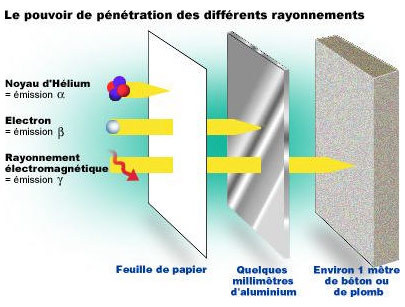
Most significant radiation exposure risks are confined to controlled areas: reactor core, primary circuit, and spent fuel handling zones.
Nuclear waste
Waste is radioactive when it contains unstable nuclei.
Radioactivity decreases over time according to each isotope's half-life.
A common simplification:
- After one half-life, activity is reduced by 50%
- After two half-lives, by 75%
- After three half-lives, by 87.5%
Most waste by volume is low-level and short-lived. A very small fraction of total volume accounts for most long-term radioactivity and requires deep geological storage solutions.
Electricity output
Typical reactor electrical output is in the range of hundreds to more than one thousand megawatts.
It helps to separate:
- Power: production rate at a given moment (W, MW, GW)
- Energy: total production over time (Wh, MWh, TWh)
| Characteristic | Power | Energy |
|---|---|---|
| Definition | Instant production rate | Total production over time |
| Units | W, MW, GW | Wh, MWh, TWh |
| Nature | Instantaneous | Cumulative |
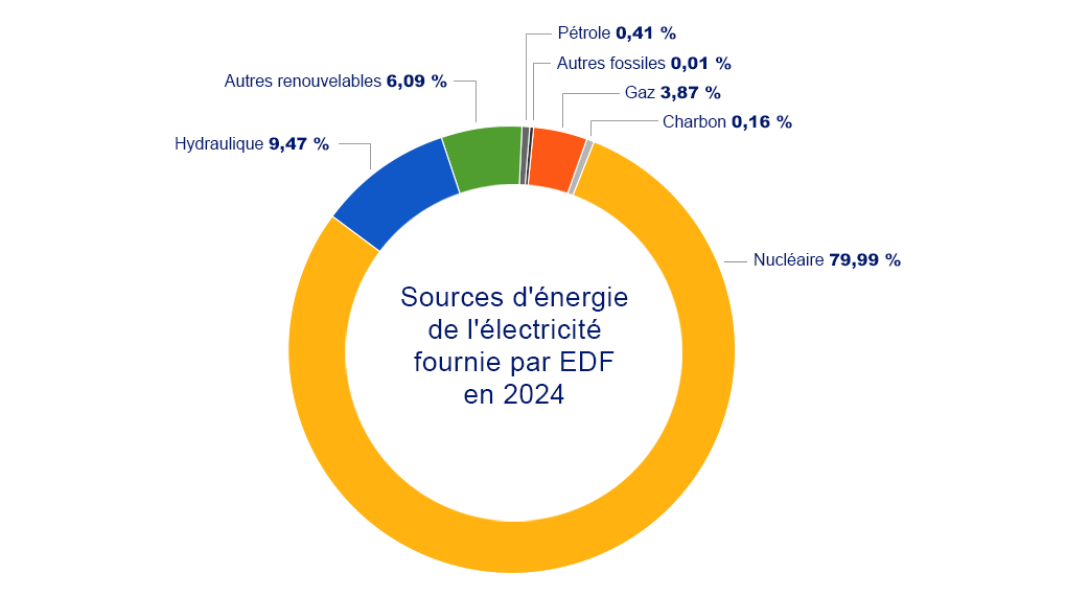
Electricity on the grid is mixed from multiple sources (nuclear, hydro, wind, solar, gas, etc.), so end users do not receive a physically separate "nuclear-only" stream.
Future nuclear technologies
Fission is mature but has constraints: long-lived waste, strict safety requirements, and limited fissile resources.
That is why many projects explore:
- SMRs (Small Modular Reactors), smaller and potentially faster to deploy
- Fusion, a long-term option with different fuel cycles
Nuclear fusion
Unlike fission (splitting heavy atoms), fusion joins light atoms together.
The Sun works this way by fusing hydrogen isotopes into helium.
On Earth, controlled fusion for electricity is still experimental. It requires extreme temperatures, plasma confinement, and stable operating conditions.
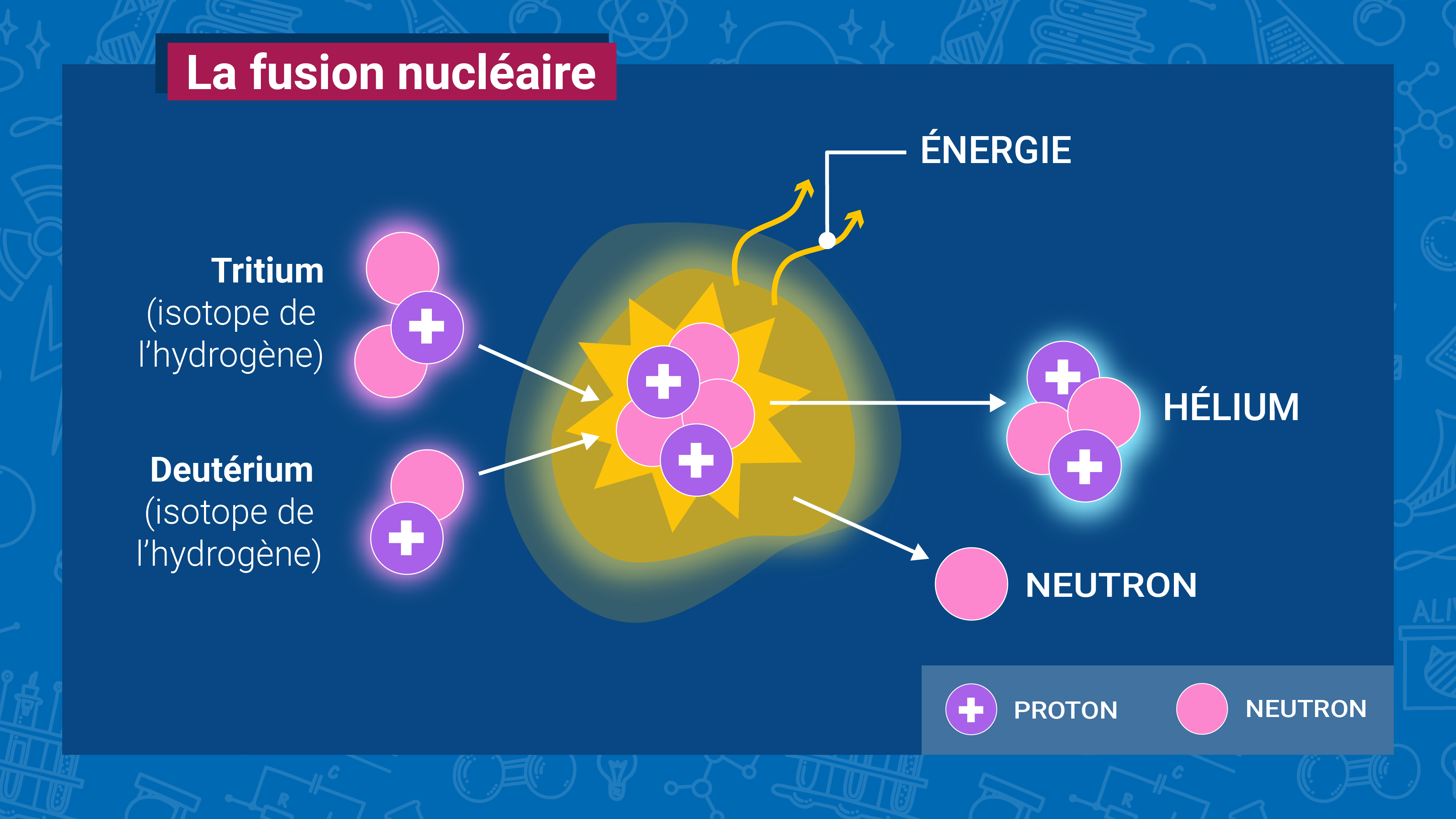
Projects like ITER and private companies are making progress, but large-scale commercial fusion power is still not ready.
Glossary
Atom: Basic unit of matter, with a nucleus (protons + neutrons) and electrons.
Fission barrier: Minimum energy required to trigger fission in a nucleus.
Coolant: Fluid used to transfer heat from the reactor core.
Nuclear fission: Splitting a heavy nucleus into lighter nuclei, releasing energy.
Nuclear fusion: Combining light nuclei into a heavier one, releasing energy.
Fissile material: Material capable of sustaining fission under neutron capture (e.g., U-235).
Moderator: Material that slows neutrons down.
Atomic nucleus: Central part of an atom containing protons and neutrons.
Fission products: Lighter nuclei created after fission.
Electrical power: Instantaneous rate of electricity production.
Sources
ASNR - Centrales nucléaires
EDF - Nucléaire en chiffres
ASNR - Qu'est-ce qu'un atome ?
Wikipedia - Fission nucléaire
Nuclear Power - Fuel consumption
La Radioactivité - Unités d'énergie
Orano - Fonctionnement d'une centrale nucléaire
Dr Nozman - Je rentre au coeur d'une centrale nucléaire
Landauer - Différents rayonnements ionisants
Les Echos - Mini-réacteurs : le nouveau rêve de l’industrie nucléaire
Planète Énergies - Fusion nucléaire
Andra
Expertise Énergie - Transformateur électrique
NASA - Fission System to Power Exploration on the Moon's Surface and Beyond